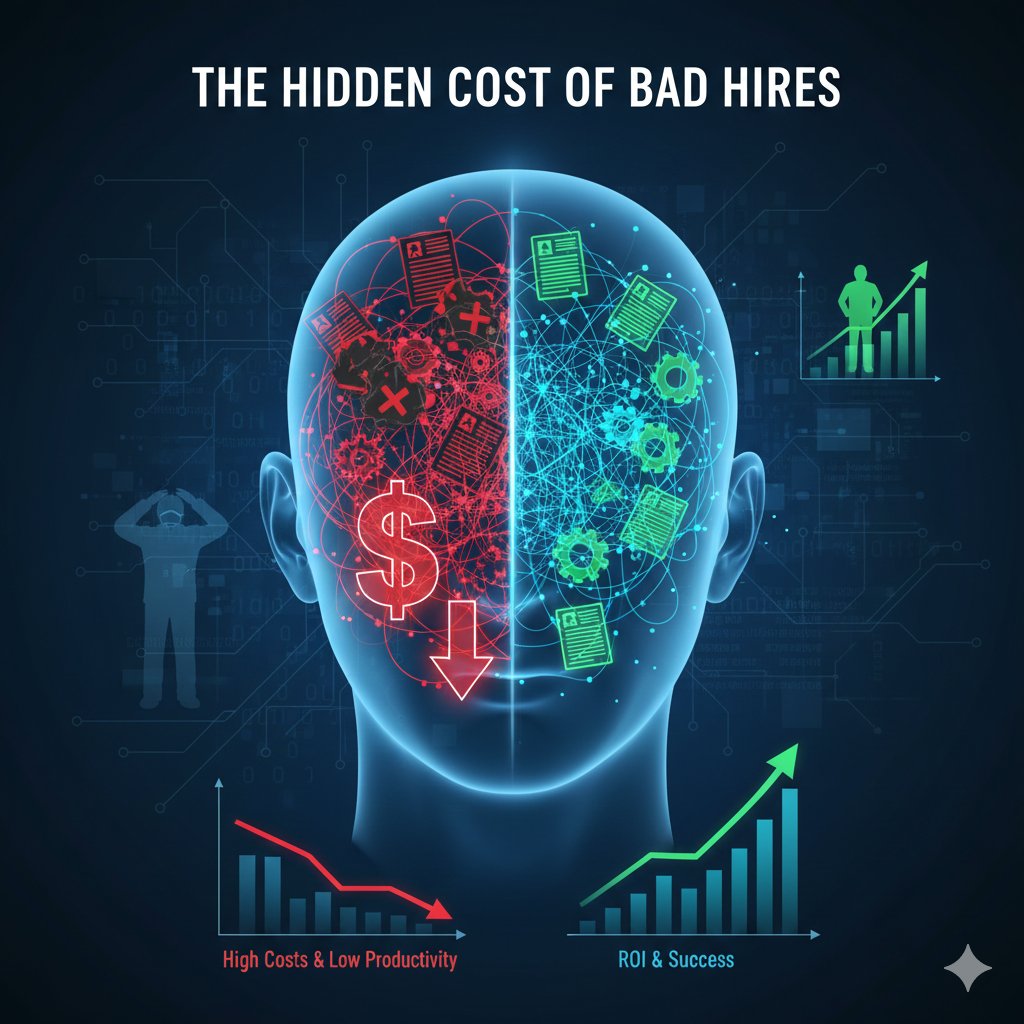
The U.S. Department of Labor estimates that a bad hire costs a company 30% of that employee's first-year earnings. For a position with a $60,000 salary, that's $18,000 lost. For senior roles, the cost can exceed $240,000 when you factor in recruitment costs, training, lost productivity, and the impact on team morale.
Yet according to CareerBuilder, 74% of employers admit they've hired the wrong person for a position. This isn't a reflection of incompetent hiring managers—it's a systemic problem with how traditional recruitment works.
Why Traditional Hiring Fails
Traditional hiring relies heavily on two flawed inputs: resume keywords and gut feelings.
The keyword problem: When recruiters scan resumes for specific terms, they're playing a matching game that candidates have learned to exploit. A study by Jobscan found that 98% of Fortune 500 companies use keyword-based applicant tracking systems, and an entire industry has emerged teaching candidates how to "beat" these systems by stuffing resumes with the right words—regardless of actual qualifications.
The gut feeling problem: Humans are remarkably poor at predicting job performance from interviews. Google's famous Project Oxygen found that traditional unstructured interviews explained only 14% of an employee's subsequent job performance. We hire people we like, not necessarily people who will excel in the role.
How AI Matching Works Differently
AI-powered candidate matching doesn't just look for keywords—it understands context, infers capabilities, and learns from outcomes.
Semantic understanding: Modern AI recognizes that "led a team of 12 engineers" and "managed engineering department" describe similar experiences, even though they share no keywords. It understands that Python experience often indicates someone can learn JavaScript quickly, and that a "Sales Director" at a 50-person startup likely has different skills than the same title at a Fortune 500 company.
Skills inference: AI can identify skills that candidates don't explicitly list. Someone who "built a mobile app from scratch and launched it to 100K users" clearly has skills in project management, user research, and product thinking—even if those words never appear on their resume.
Success pattern recognition: The most powerful aspect of AI matching is its ability to learn from your company's hiring outcomes. By analyzing which past hires succeeded and which struggled, AI can identify patterns that predict success in your specific environment.
Real-World Impact
Organizations using AI-powered candidate matching report significant improvements in hiring quality:
- 40% reduction in mis-hires (employees who leave or are terminated within 18 months)
- 25% improvement in hiring manager satisfaction with candidates presented
- 2x increase in interview-to-offer conversion rates because candidates are better matched from the start
- Faster ramp-up times as better-matched employees reach full productivity sooner
The Human Element Remains Critical
AI matching doesn't replace human judgment—it enhances it. The technology handles the data-intensive work of evaluating hundreds of candidates against dozens of criteria. Humans then focus their expertise on final-stage assessments: cultural fit, career aspirations, team dynamics, and the intangible qualities that make someone right for your specific team.
The result is a hiring process that combines the scalability and consistency of AI with the nuanced judgment that only humans can provide. Bad hires become rarer, good hires become more common, and the entire organization benefits from teams built on genuine capability rather than keyword matching and gut feelings.