Here's a statistic that should concern every hiring manager: according to research from Officevibe, the best candidates are typically off the market within 10 days. Yet the average time-to-hire across industries is 36-44 days. By the time most companies make an offer, their top choices have already accepted positions elsewhere.
This isn't just a minor inconvenience—it's a systematic disadvantage that results in companies consistently hiring their second or third-choice candidates while competitors snap up the best talent.
Where Traditional Hiring Loses Time
When we analyze traditional hiring pipelines, we find time leaks at every stage:
- Application review: 5-7 days for initial screening
- Scheduling: 3-5 days of back-and-forth to find interview times
- Interviewer availability: 1-2 week wait for busy hiring managers
- Decision making: 3-5 days for internal discussions
- Offer preparation: 2-3 days for approvals and paperwork
Each stage seems reasonable in isolation, but they compound into a process that takes weeks while candidates grow impatient and accept other offers.
The 24-Hour Pipeline: How It Works
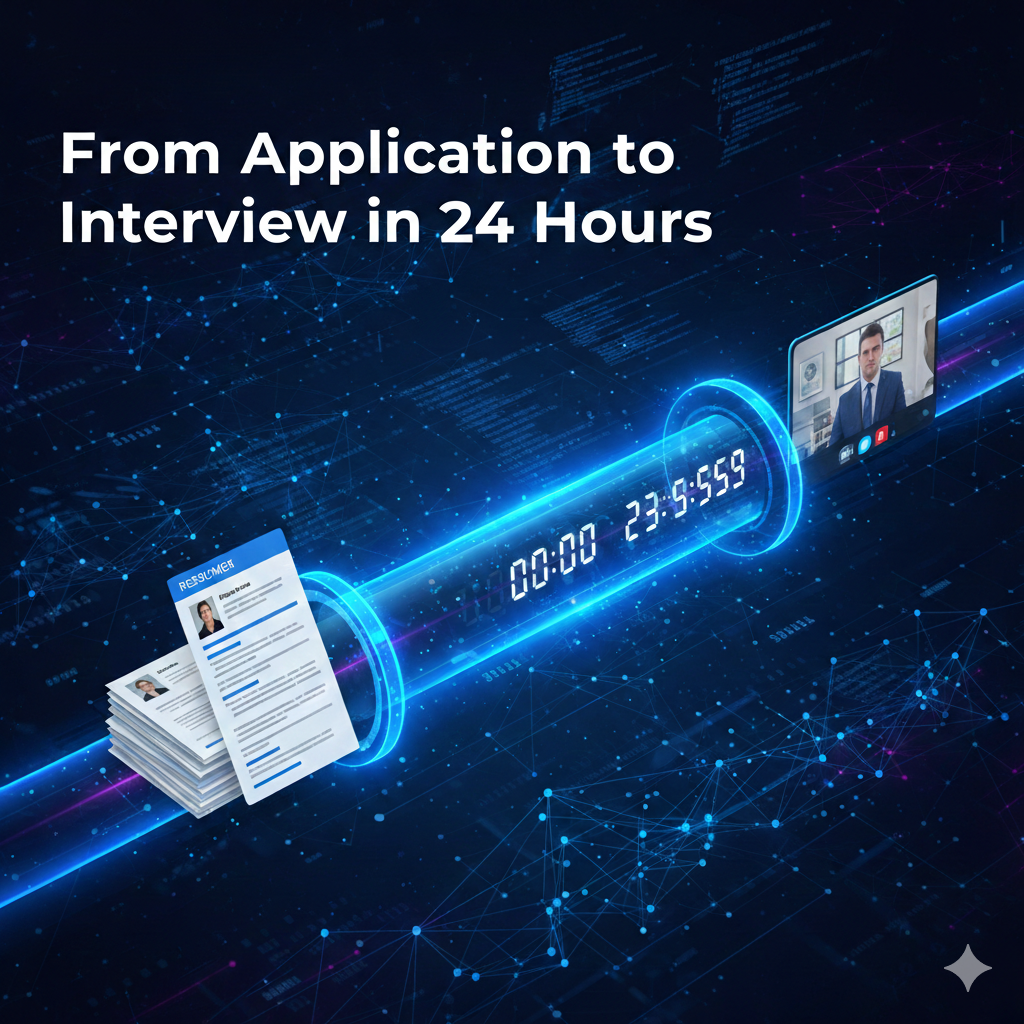
Leading companies are now achieving what seemed impossible: moving qualified candidates from application to first interview within 24 hours. Here's how:
Instant parsing and scoring: When a candidate applies, AI immediately parses their resume, extracts relevant information, and scores them against job requirements. Within seconds, the system knows whether this candidate warrants immediate attention.
Automated initial screening: For candidates who meet the basic criteria, an AI interviewer can conduct an initial screening conversation immediately—no scheduling required. The candidate completes the screening at their convenience, whether that's 2 PM on a Tuesday or midnight on a Saturday.
Smart scheduling: Candidates who pass initial screening are automatically offered interview slots based on real-time interviewer availability. No email ping-pong, no coordinator bottlenecks—just instant access to available times.
Parallel processing: Instead of sequential reviews where candidates wait at each stage, AI enables parallel processing. While a candidate completes their AI interview, their resume is being reviewed by the hiring manager, and their references are being checked. Everything happens simultaneously.
The Candidate Experience Advantage
Speed isn't just about efficiency—it's about candidate experience. When a candidate applies and receives an interview invitation within hours instead of weeks, it sends a powerful message: this company is organized, respectful of my time, and genuinely interested in me.
Candidates consistently rate fast-moving companies as more attractive employers, even when competing offers have higher salaries. In a competitive talent market, speed itself becomes a differentiator.
Implementing Rapid Hiring Without Sacrificing Quality
Speed without quality is worthless. The key is using automation to eliminate delays while maintaining rigorous evaluation. AI handles the time-consuming logistics—parsing resumes, conducting initial screens, scheduling interviews—while human experts focus on high-value assessment and decision-making.
Companies using this approach report not only faster hiring but better hiring. When you're consistently interviewing candidates within 24 hours of application, you're meeting them at their peak interest and availability. You're evaluating them before they've been coaching by competitors' interview processes. And you're making offers while they're still excited about the opportunity.